Types of pedestals
We offer two main types of pedestals:
-
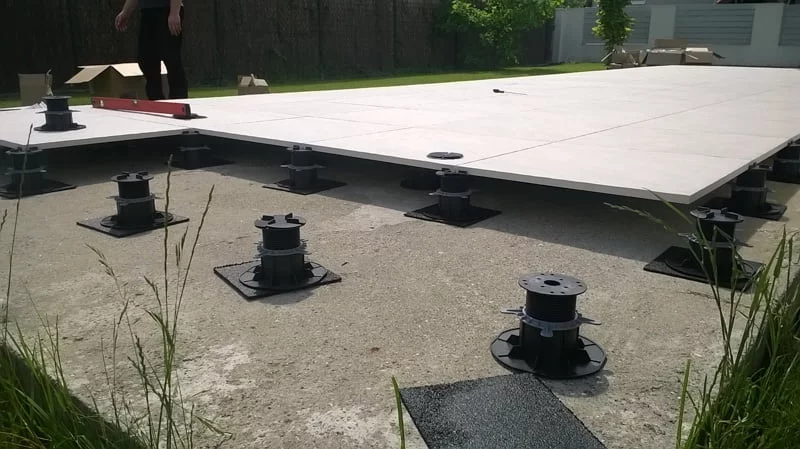
Adjustable pedestals for patio slabs – designed for installing patios with concrete, porcelain or ceramic slabs. They feature special spacers that allow the slabs to be laid evenly with expansion gaps between them.
-
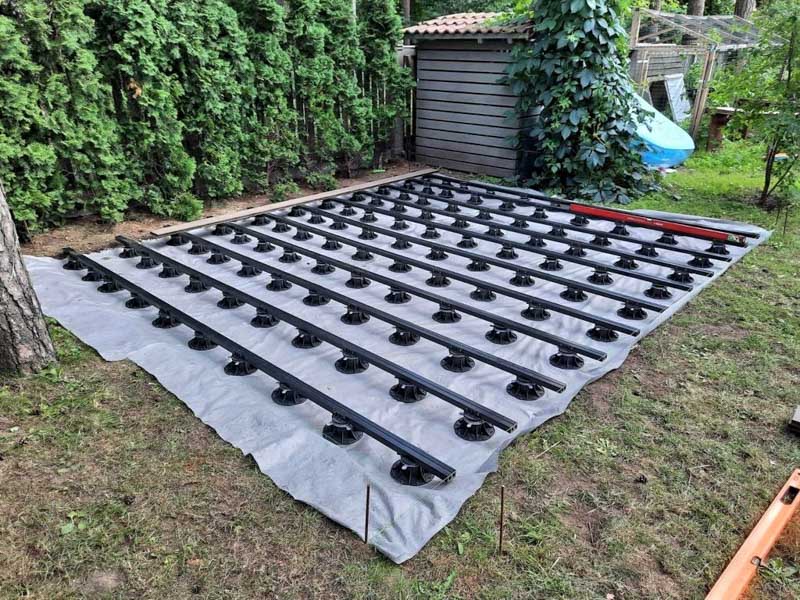
Adjustable pedestals for joists – designed to support composite or timber joists, which form the base for decking boards. They have a special head designed to hold the joist securely and can often be screwed to it for added stability.
How to install pedestals?
1. Preparing the ground
Pedestals do not need to be anchored to the ground, but the ground should be stable, firm and level – the following surfaces work best:
-
concrete screed,
-
paving slabs,
-
compacted hardcore with geotextile membrane and a sand layer.
On uneven ground, the pedestals can be adjusted by several centimetres or even up to a dozen centimetres (the exact range depends on the model).
2. Spacing and number of pedestals
-
For concrete paving slabs: we recommend using 4 pedestals for each slab (approximately 4–6 pedestals per 1 m², depending on the slab size).
-
For joists: on average, you need 5–7 pedestals per 1 linear metre of joist, which works out at around 6–8 pedestals per 1 m² of patio – depending on the joist size and the planned load.
3. Height adjustment
The pedestals have a continuous height-adjustment system – this is usually operated by turning the threaded spindle by hand or with a spanner. This allows you to level the patio perfectly, without having to cut joists to size or adjust the height of the slabs.