
Decking joist supports
Explore the category and get advice on choosing the right products ↓Categories and filters ▾
Categories
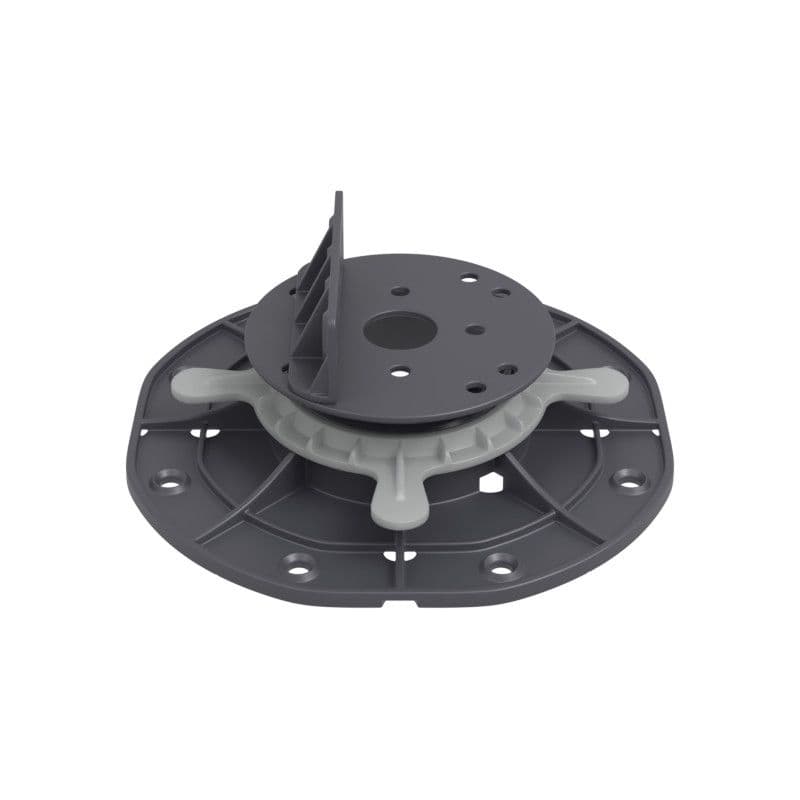 STANDARD adjustable decking pedestal for joists€2.43Request a quote
 SPIRAL LOW adjustable decking pedestal for joists€2.15Request a quote
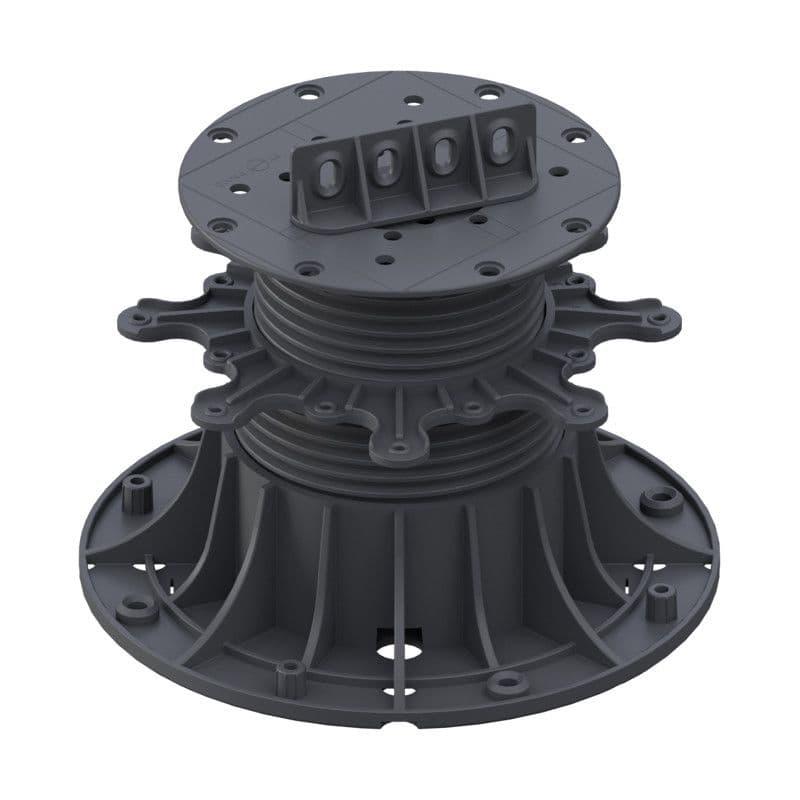 MAX adjustable decking pedestal for joists€4.91Request a quote
 SPIRAL HIGH adjustable decking pedestal for joists€4.21Request a quote
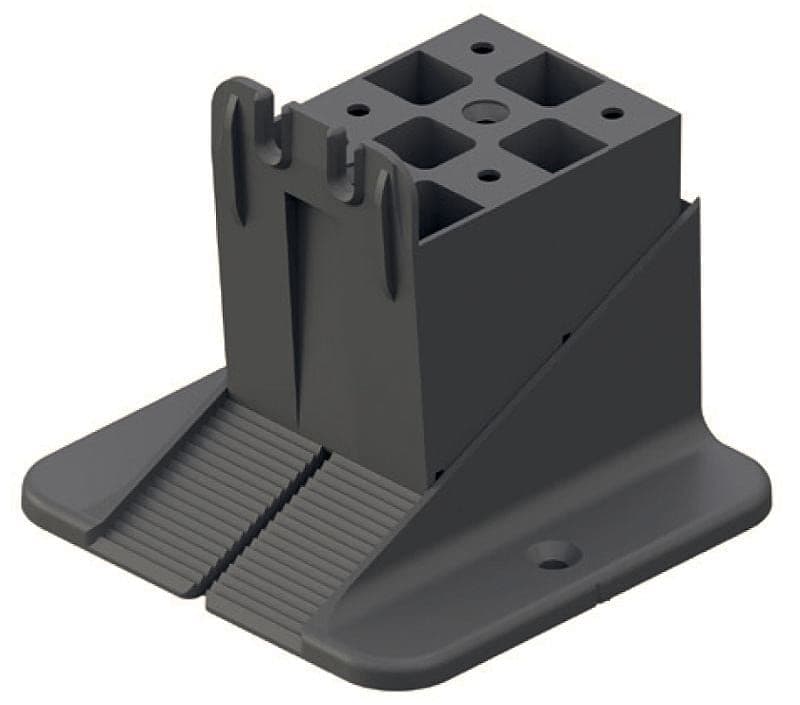 RAPTOR adjustable decking pedestal for joists€1.00Request a quote
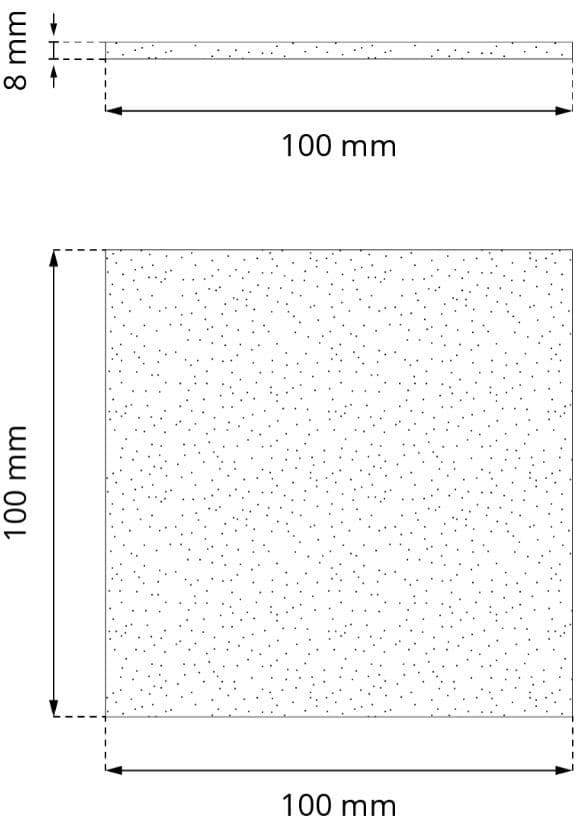 SBR rubber pads for joists 100x100x8 mm SBR100/8 104162€0.92Request a quote
About this category: Decking joist supportsRead more ↓
What are decking joist pedestals?
Decking joist pedestals allow you to create a simple, inexpensive supporting structure for decking without the need for special preparation of the base. The pedestals are adjustable, allowing them to accommodate uneven ground while keeping the structure in a fixed position.
Decking joist pedestals – benefits
The benefits of decking joist pedestals most frequently highlighted by users and specialists are:
- automatic adjustment to uneven ground: adjustable pedestals allow the height of the deck to be adapted to the terrain. This eliminates the need for additional groundworks where the ground is uneven;
- resistance to weather damage: the pedestals are made from plastics that resist the harmful effects of weather conditions such as rain, snow, temperature changes, moisture and changes in air humidity;
- high load-bearing capacity: the pedestals can withstand a load of 1000 kg, making them highly resistant to structural loads;
- Easy installation and faster fitting of other components: installing both the decking joist pedestals themselves and other structures on the pedestals is very quick and simple.
High load-bearing capacity
Pedestals must be very strong to support the weight of the joists and additional loads, such as decking boards, furniture and people spending time on the deck. The components should be weather-resistant, which is crucial to their durability, and allow quick and easy installation. Well-chosen pedestals extend the service life of the deck, ensure its stability and safety, and allow level adjustment, which is particularly important on uneven ground. The high load-bearing capacity of decking joist pedestals is essential for the safety of people using the deck.
How should decking joist pedestals be used?
Installing pedestals is not difficult and essentially involves three simple steps:
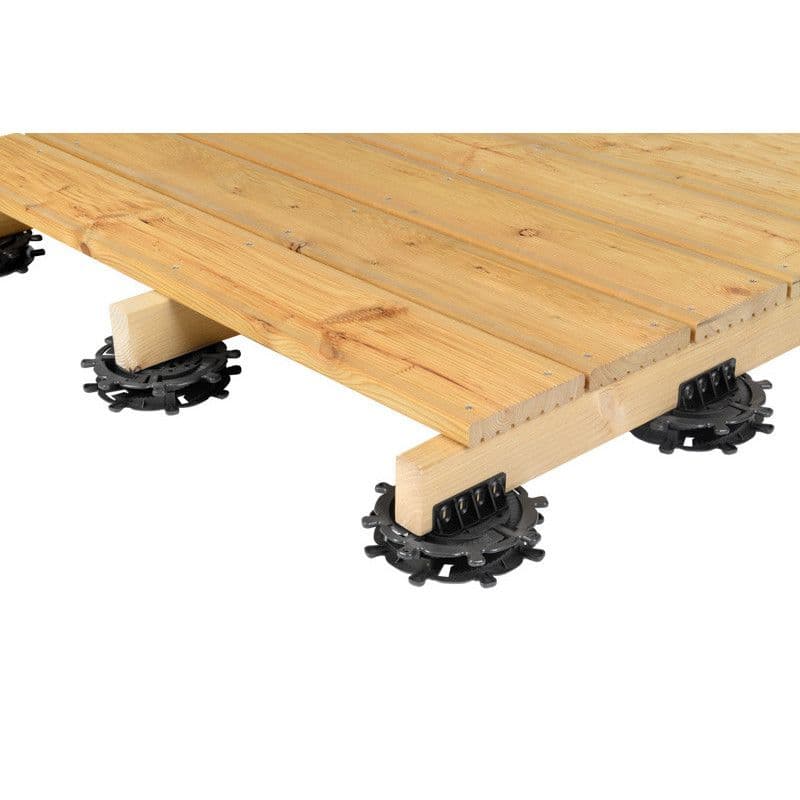
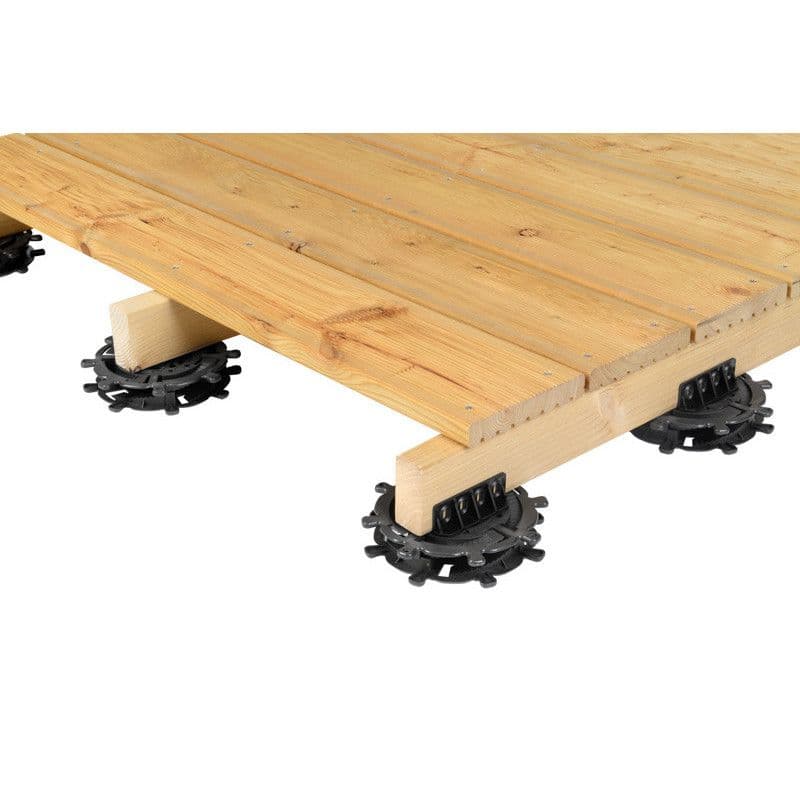
- Position the pedestals on the ground so that they stand firmly without rocking.
- Space the pedestals at suitable intervals. The joists should not bend.
- Screw the joists to the pedestals. This creates a fixed structure with an adjustable height.
Decking joist pedestal models
Our range includes several types of decking joist pedestals from recognised manufacturers, such as:
- MAX adjustable decking joist pedestal,
- RAPTOR adjustable decking joist pedestal,
- SPIRAL HIGH adjustable decking joist pedestal,
- SPIRAL LOW adjustable decking joist pedestal,
- STANDARD adjustable decking joist pedestal.
All the models listed can form an excellent structure when combined with other materials available from our shop, such as decking joists, decking boards and other garden construction components.
How many pedestals does a deck or terrace need?
It all depends on whether the pedestals will be used under concrete slabs or joists. For concrete slabs, allow 4 pedestals per slab, or around 4–6 pedestals per 1 m², depending on the slab format. For joists, use around 6–8 pedestals per 1 m², depending on the expected load.
Are there any differences between individual pedestals?
The pedestals in our range differ mainly in their application – under concrete slabs or under joists. Individual pedestals also have different adjustment ranges. We offer pedestals with adjustment from 1 cm up to 72 cm.
How much vertical space is needed to build a deck?
The minimum height of a deck made from composite decking boards is around 4.5 cm. Our smallest joist measures 2 cm, and the board is 2.3–2.5 cm thick. The standard composite system is 5.5 cm high, so if the distance from the ground to the patio door threshold is 7 cm, you can opt for a slight fall or use a pedestal to bring it flush.
How can the sides of a deck on decking pedestals be finished?
The sides of a deck on pedestals can be finished with cover trims or special fascia boards. This creates a neat appearance and conceals the supporting structure.
Are the pedestals visible after the deck is installed?
No, the pedestals are not visible. They are usually concealed by cover trims or boards.
Can pedestals be used on a balcony or roof with insulation?
Yes, pedestals can be used on balconies and roofs with insulation. However, it is important that the base is stable and adequately protected against damage.
Can pedestals be installed directly on the ground?
No, pedestals are not installed directly on the ground. The base should be hard-surfaced, for example with concrete slabs or block paving, to ensure the stability of the structure.
Do we manufacture the pedestals?
No, we are a distributor. The manufacturer is DD Group.
Do decking pedestals need to be screwed to the base?
Decking pedestals do not usually need to be screwed to the base. Their weight, together with the decking structure, provides stability, although additional fixing can be used in some cases.
How do you choose the right pedestal height for a deck?
The pedestal height is chosen based on variations in the level of the base and the planned deck height. It is best to measure the minimum and maximum heights at the installation site and choose adjustable pedestals accordingly.