Aluminium or composite joists – which provide a more stable deck?
Aluminium or composite joists for composite decking boards? We compare the stability, durability, installation and applications of both options. Find out which joists to choose for a composite deck.
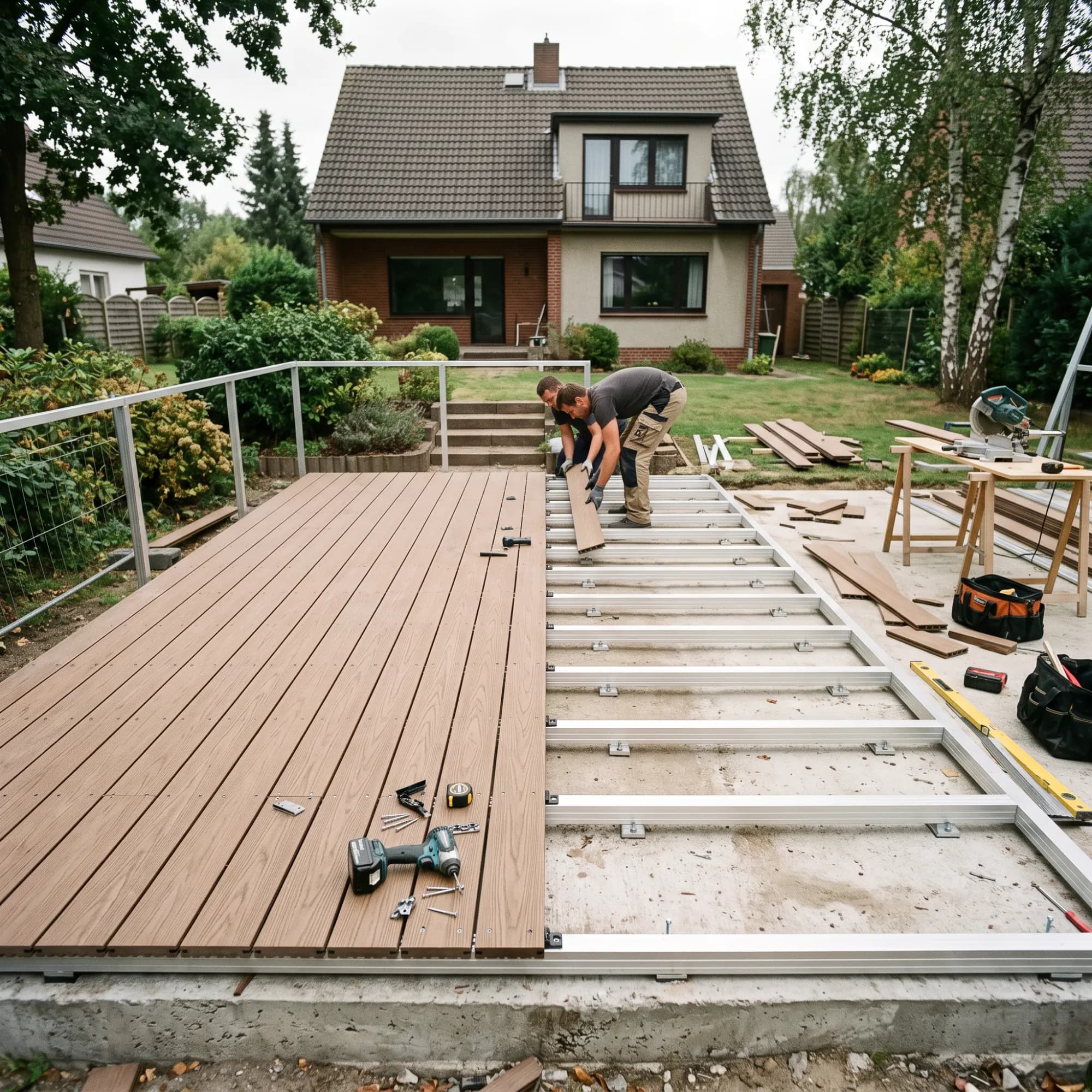
When choosing a composite decking board, most investors focus on the colour, surface texture and appearance of the finished terrace. This is natural – the decking boards are what will be visible every day. However, there is an element that is practically invisible once installation is complete, yet is extremely important for the stability of the entire surface. This is, of course, the joists. Joists for composite decking boards form the supporting structure for the boards, transferring loads to a suitably prepared base or support system. Their type, profile, spacing and method of support can determine whether the terrace is rigid and stable. Investors most often consider two options: aluminium joists and composite joists. Which are better? If we are analysing structural rigidity above all, aluminium usually offers greater potential. This does not mean, however, that composite joists are a poor choice. In a correctly designed system, they can work very well on a typical terrace at home. The key is to match the structure to the specific project.
What function do joists serve beneath composite decking boards?
Joists form a kind of skeleton for the terrace. The composite decking board is fixed to them using fixing clips and other components specified for the system in question. Their main purpose is to provide suitable support for the boards and transfer loads. A well-built structure also helps maintain the correct gaps, ventilation and surface geometry. It is therefore a mistake to treat joists as ordinary battens that can be replaced with any similar profile. The structure should be built in accordance with the decking board manufacturer's instructions and the project requirements.
Composite joists – what are their characteristics?
Composite joists are often offered as part of a complete WPC system. Like composite decking boards, they are made from materials containing wood and polymer components, although the exact composition depends on the manufacturer. A key advantage is their resistance to typical conditions beneath a terrace and their compatibility with system fixing components. WPC joists work particularly well in low-level structures where they have regular, stable support. A typical example might be a terrace built on a prepared concrete slab, where the joist has suitably spaced support points in accordance with the system instructions.
Advantages of composite joists.
One of the arguments in favour of composite joists is their natural compatibility with many WPC decking board systems. With a complete system, the manufacturer may supply the decking board, joist, starter clips, intermediate clips and finishing components. This makes it easier to select components and reduces the risk of accidentally combining products that are not compatible. Composite joists are also resistant to moisture in the way typical of WPC materials and do not require impregnation like traditional timber components. They are therefore well suited to many standard projects at detached houses.
Are composite joists stable?
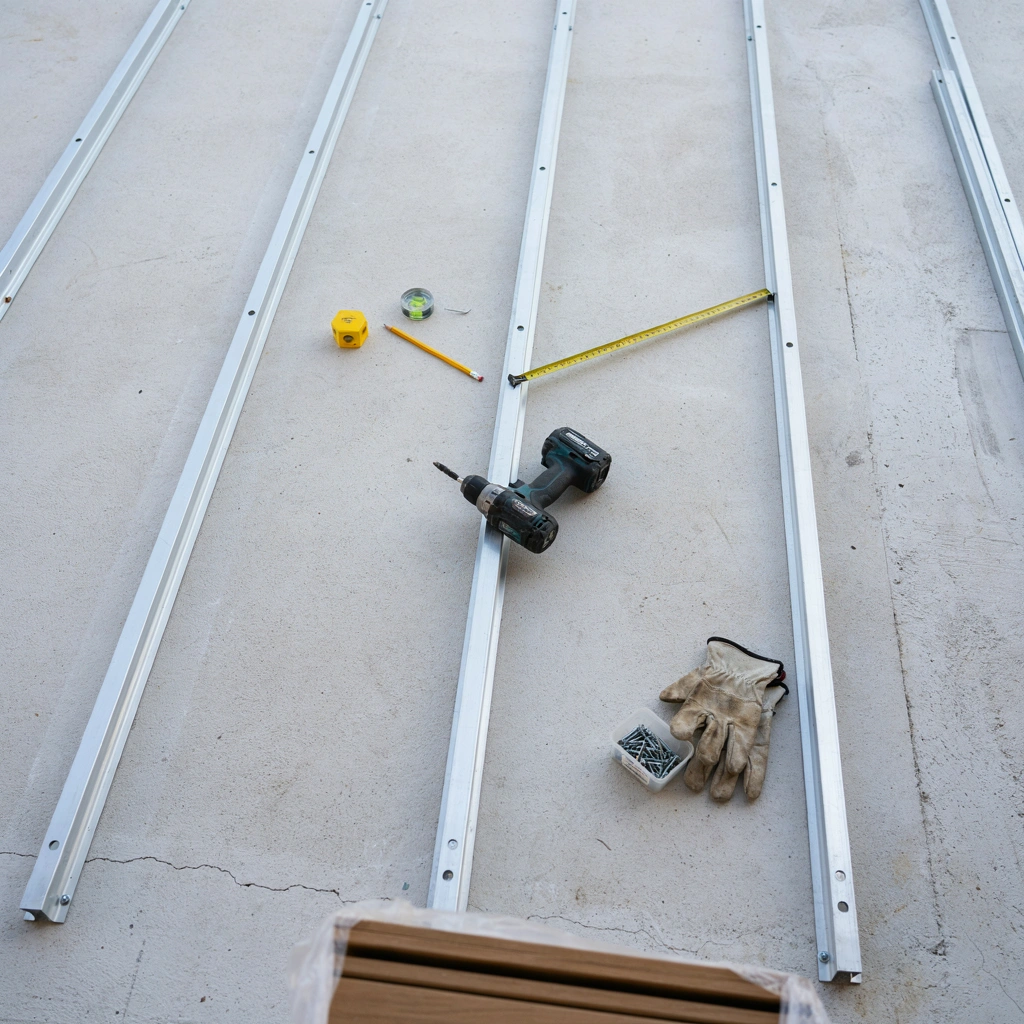
Yes – provided they are used correctly. However, it is important to distinguish the stability of the finished system from the rigidity of the profile itself. A composite joist should not automatically be treated as a structural beam capable of spanning large distances. Many WPC profiles require relatively frequent, stable support. If the support points are spaced too far apart, the structure may flex more than the manufacturer intended. Therefore, during installation, you should check not only the spacing of the joists beneath the decking boards, but also the maximum spacing between the joists' own support points. These are two different measurements.
Aluminium joists – why are they so popular?
Aluminium joists are increasingly used in professional decking structures. Their greatest advantage is the favourable ratio of weight to stiffness, along with aluminium’s resistance to atmospheric corrosion thanks to its natural oxide layer. A suitably selected aluminium profile can create a very rigid and stable structure. This is particularly important for larger decks, systems installed on adjustable supports and more demanding projects. Aluminium also offers high dimensional consistency. The profiles are straight and predictable, making it easier to create a level surface for composite decking boards.
Do aluminium joists provide a more stable deck?
If we compare profiles intended for a specific project and correctly selected for the structure, aluminium joists generally offer greater rigidity than standard WPC joists. This is one of the most important differences between these materials. However, this does not mean that every aluminium profile will automatically be better than every composite joist. The profile cross-section, wall thickness, support method, loads and the overall structural design all matter. A thin profile used outside its intended application may also fail to meet expectations. That is why you should always assess the specific system, not just the material the joist is made from.
Aluminium joists on adjustable supports.
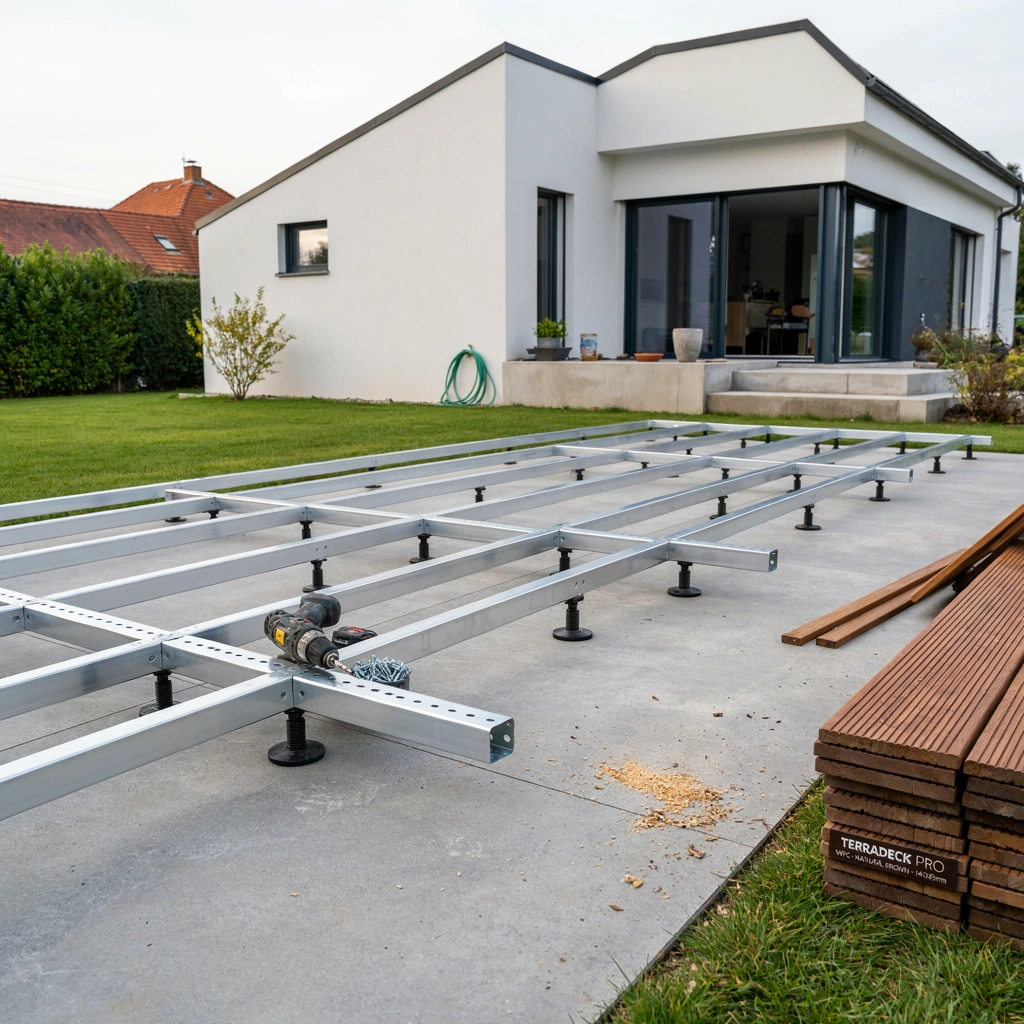
This is where aluminium demonstrates one of its greatest advantages. Adjustable decking supports allow the structure to be raised above the ground and the deck height to be set precisely. This solution is used, among other places, on concrete slabs, roofs and balconies, and for projects that require the surface level to be raised. Combined with suitably designed aluminium profiles, it can create a very stable structure. However, the height and spacing of the supports, the method of attaching the profiles and any bracing should all be tailored to the design. The higher the structure, the more important it becomes to brace it correctly.
And what about moisture?
Moisture regularly builds up beneath decking. Rain can pass through the gaps between the boards, so the structure must be suitable for outdoor conditions. Both high-quality composite joists and aluminium profiles used correctly perform well in these conditions. Regardless of the material, however, ensure that water can drain away freely. The structure should not be designed in a way that allows water to pool beneath the deck. With aluminium, you should also select the fasteners correctly and take environmental conditions into account, particularly where the structure may come into contact with other metals or an aggressive environment.
Which joists are easier to install?
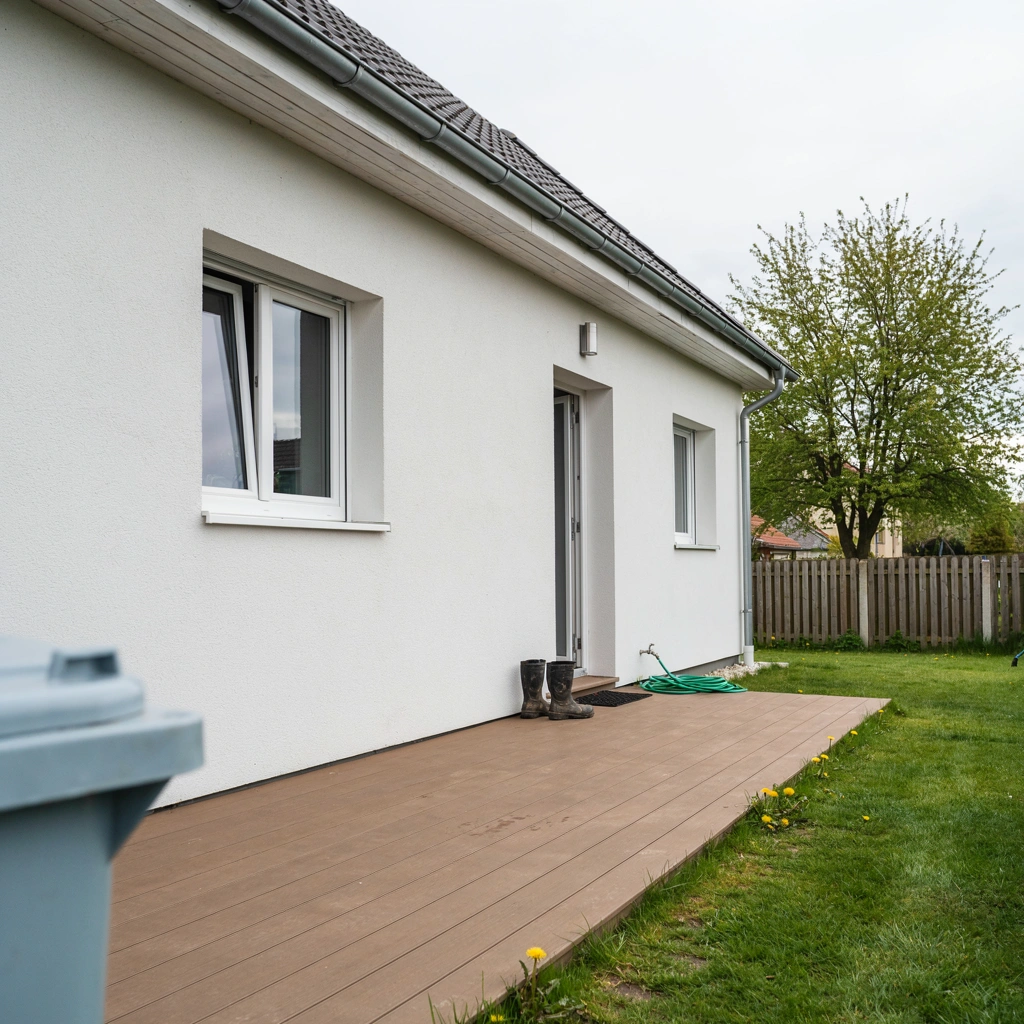
Much depends on the deck structure. On a low, level concrete slab, composite joists can be a simple and practical solution. The system is straightforward, and installation can be carried out using compatible accessories. Aluminium profiles need to be cut appropriately and require suitable connecting components. On the other hand, their straightness and rigidity help when levelling larger structures. For a professional team, neither solution should pose a problem. More important than ease of installation alone is building the structure in accordance with the design.
Joist spacing for composite decking boards.
Whether we choose aluminium or WPC, we must follow the maximum joist spacing for composite decking boards. Many systems use spacing of around 30–40 cm between centres for a standard board layout, but this is not a universal rule. Each model may have different requirements. If the manufacturer specifies a maximum spacing of, for example, 35 cm, using a more rigid aluminium joist does not mean you can automatically increase it to 50 cm. The decking board needs an appropriate number of support points, and its instructions specify the maximum permitted spacing of the structure beneath the surface.
Joist spacing and support spacing – don’t confuse these measurements.
This is one of the most important aspects of the whole subject. Joist spacing is the distance between consecutive joists beneath the boards. Joist support spacing, by contrast, indicates how often the joist itself must be supported by concrete, pads, supports or another structure. It is therefore possible for joists to be spaced 35 cm apart, while each one needs support at different intervals along its length. In a suitably designed system, a more rigid aluminium profile may allow different spans than a composite profile. However, the specific values must be based on the properties of the profile used and the design.
Deck stability depends on more than the joist material.
You can buy a very good aluminium profile and still build an unstable deck. How is that possible? If the supports are poorly positioned, the ground is unstable, suitable bracing is missing or the components are connected incorrectly, the quality of the joist alone will not solve the problem. The stability of a composite deck is affected by all of the following:
- joist type and cross-section,
- joist spacing,
- spacing of support points,
- ground quality,
- how the structure is connected,
- deck height,
- loads,
- how the boards are installed,
- expansion gaps and ventilation.
A deck should therefore be treated as a complete structure.
When to choose composite joists?
Composite joists are worth considering primarily for low-level decking built on a stable base, where frequent support can be provided in accordance with the manufacturer's requirements. They can be a good choice when:
- you are building a standard deck next to your home,
- you have a level and stable base,
- you are using a complete system from the manufacturer,
- the structure does not require large spans,
- you want a straightforward, system-based solution.
There is no need to rule out WPC simply because aluminium is stiffer. If a composite joist is intended for the application and is properly supported, it can perform its function for many years.
When should you choose aluminium joists?
Aluminium joists are particularly worth considering for more demanding projects. They are worth considering for large decks, structures on adjustable supports, unusual layouts and anywhere high structural stiffness is important. They can also be a good solution for decks built on roofs or other surfaces where the ability to design the entire supporting system precisely is important. In these cases, the higher cost of the profile itself may be justified by its structural capabilities.
Is aluminium always more expensive?
An aluminium profile will usually cost more than a basic composite joist, but comparing the price of a single piece does not give you the full picture. You need to calculate the cost of the whole system:
- number of joists,
- support points,
- supports,
- connectors,
- stiffening components,
- installation time.
Only then can you compare the actual cost of the two solutions. The cheapest structure at the point of purchase does not always prove to be the most cost-effective over the entire service life of the deck.
The most common mistakes when choosing joists.
The first mistake is choosing a joist solely on the basis of price. The second is assuming that all profiles made from the same material have identical strength. Another common problem is using random substitutes without checking their compatibility with the fixing clips and composite decking board. You should also avoid:
- exceeding the permitted spacings,
- reducing the number of supports without calculations,
- laying joists on an unstable base,
- ignoring board joints,
- omitting the required stiffening.
A few additional structural components usually cost far less than repairing a finished deck later.
FAQ – aluminium or composite joists?
Which joists are more stable – aluminium or composite?
In terms of stiffness, suitably selected aluminium joists generally outperform typical composite profiles. However, the stability of the finished deck depends on the design of the entire structure, not just the joist material.
Are composite joists suitable for composite decking boards?
Yes. They are a standard solution in many systems. However, they must be properly supported and installed in accordance with the manufacturer's instructions.
Can WPC decking boards be installed on aluminium joists?
Yes, if the board manufacturer and the fixing system used allow this solution. Compatible fixing clips and connectors must be selected.
How closely should joists be spaced under composite decking boards?
This depends on the specific board model. Spacing of around 30–40 cm between centres is common, but always follow the maximum spacing specified in the manufacturer's instructions.
Can a composite joist span between supports without support underneath?
The joist must be supported at the intervals specified by the manufacturer. Typical WPC joists should not be treated as general-purpose structural beams capable of carrying loads over long spans.
What should you choose for a deck on adjustable supports?
Aluminium profiles are often used in more demanding structures on supports because of their stiffness. However, the final choice should be based on the specifications of the particular system and the design.
Aluminium joists or composite – which should you ultimately choose?
If the most important criterion is maximum structural stiffness, suitably designed aluminium joists will generally be the stronger solution. They are particularly well suited to larger decks, raised structures and systems using adjustable supports. Composite joists, on the other hand, remain a very good choice for many standard projects, especially on a stable base with suitably close support spacing. One of their major advantages is the ability to create a complete system together with the boards and dedicated accessories. The most important question, then, is not: “which material is always better?”, but: “which system is right for my deck?” A good composite decking board needs a properly designed structure. The correct joist spacing, stable support, suitable fixing clips, expansion gaps and proper water drainage are just as important as choosing between aluminium and WPC. When all these elements are well matched, the finished deck made from composite decking boards will be stable, level and comfortable to use every day for many seasons to come.
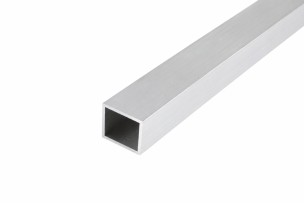
Square aluminium profile 18x18x1 mm
Available lengths: 1m | 2m | 4m | 6m
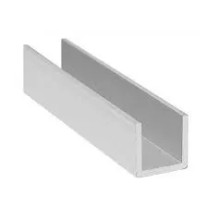
Aluminium channel 10x10x1.5 mm
Available lengths: 1m | 2m | 4m | 6m
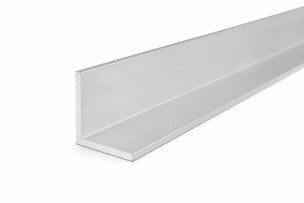
Aluminium angle 100x50x5 mm
Available lengths: 1m | 2m | 4m | 6m
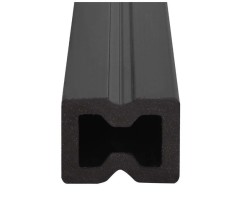
SELECT composite decking joist 30x40 (graphite) - 2m
30 x 40 x 2000