
A modern terrace with a hot tub: why is composite decking the best choice?
Find out why composite decking boards are the best surface for a hot tub. Read our advice on installation, durability and caring for a patio beneath your spa.
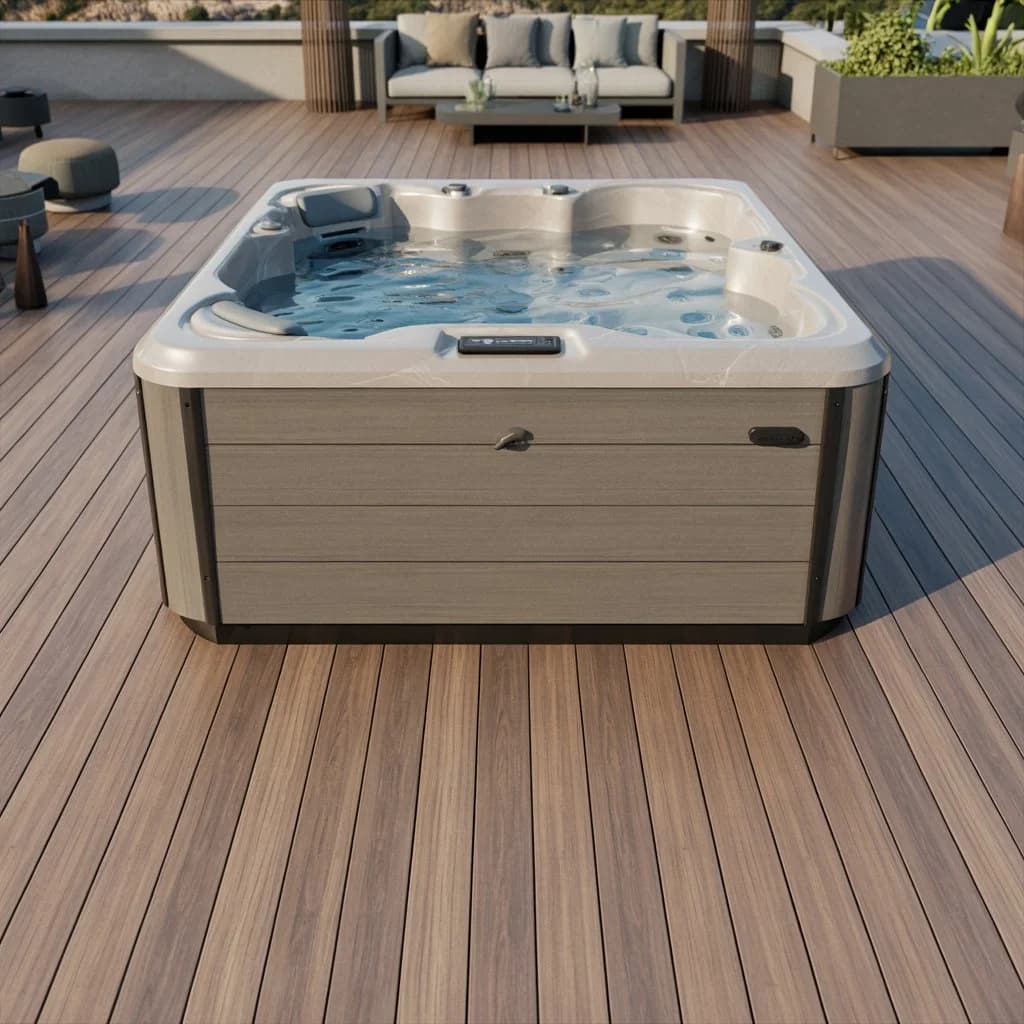
A private outdoor relaxation area is a dream for many homeowners. Imagine an evening after a hard day: a hot hydro-massage bath, gentle lighting and surroundings that are a pleasure to look at. The key to the success of this investment, however, is not the hot tub itself, but the surface it rests on. Choosing a material for a hot tub terrace is a decision that will last for years, affecting not only its appearance but, above all, the safety and durability of the structure. In this article, we’ll look at why composite decking (WPC) has come to dominate the market and become an unrivalled solution for a home spa.
1. Strength and load-bearing capacity: Can composite decking support a hot tub?
This is the most common question investors ask. A standard hot tub for 4-6 people can weigh from $1500$ to as much as $2500$ kg once filled with water and occupied by users. This is an enormous point load.
Composite decking is an exceptionally dense material that resists deformation. The secret, however, lies in the right substructure. Composite systems are supported by closely spaced joists, which helps distribute the weight evenly. Unlike natural wood, composite decking has no knots or internal cracks that could weaken the board’s structure under heavy pressure. By choosing high-quality composite decking (solid rather than hollow in areas subject to the greatest pressure), you can be confident that your terrace will remain stable for decades.
2. Resistance to moisture and pool chemicals.
A hot tub is a high-humidity environment. Water containing chlorine or salt regularly splashes onto the boards, which spells disaster for natural wood, leading to rot, decay and fungal growth.
Composite decking (Wood Plastic Composite) is made from wood flour and polymers (most commonly HDPE). This means:
- It does not absorb water: Its absorption rate is close to zero.
- It is resistant to chlorine: The harsh chemicals used to disinfect hot tubs do not discolour composite decking boards.
- No mould: Polymers inhibit the growth of microorganisms, which is crucial in areas where water often collects in the gaps.
3. Safety first: Slip resistance and no splinters.
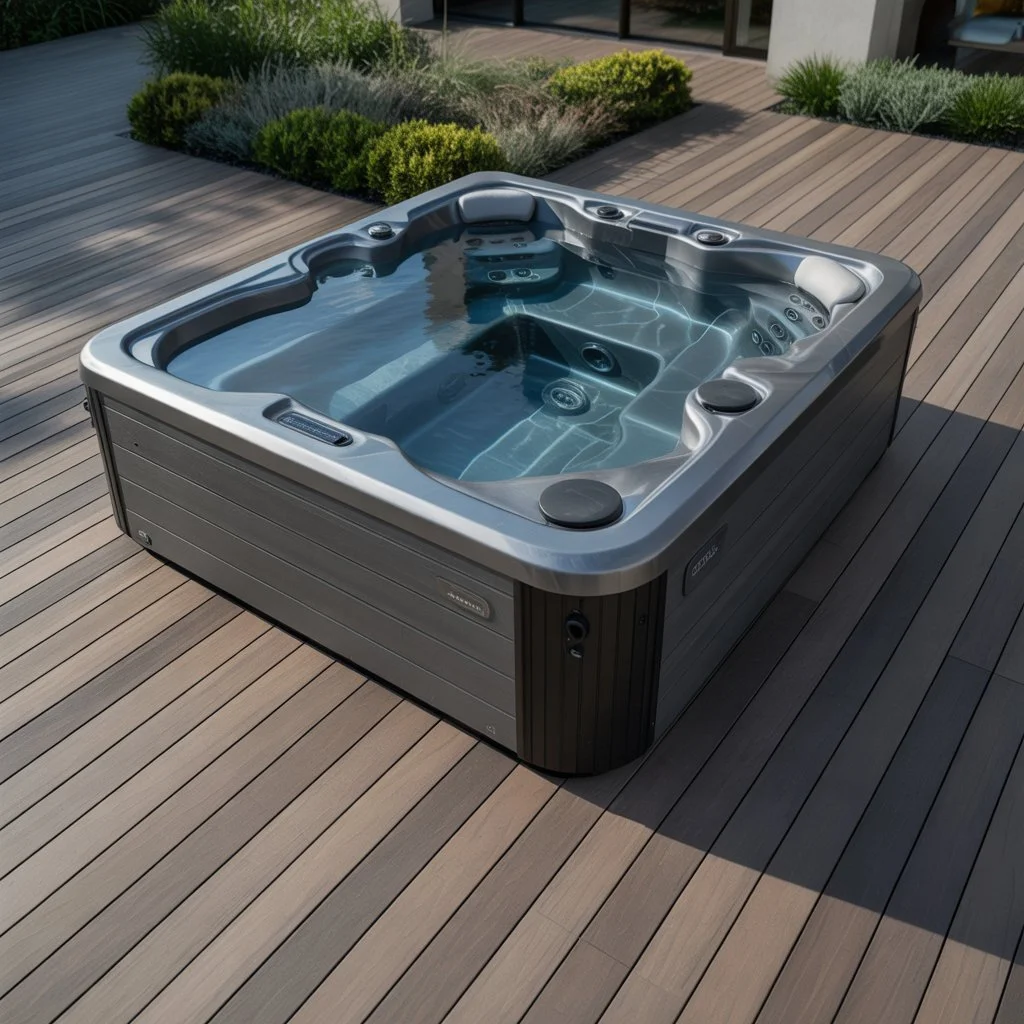
When you get out of the hot tub, your feet are wet. On traditional ceramic tiles or smooth timber, it’s easy to have an accident. Composite decking boards are designed with safety in mind: most feature a grooved surface (with longitudinal grooves) or a wood-effect texture with a high slip-resistance rating.
What’s more, composite decking never cracks in a way that creates splinters. You can walk barefoot around the hot tub without worrying about getting a sharp piece of wood stuck in your foot. This is a key consideration for families with children.
4. The look of a modern spa.
A modern terrace is an extension of your living room. Composite decking offers consistent colour and a minimalist look that pairs perfectly with the modern design of a hot tub.
- A wide range of colours: From cool anthracite and grey (a recent-season favourite) to warm teak and walnut shades.
- No need to paint: Unlike Siberian larch or exotic timber, composite decking does not turn grey (develop a patina) as dramatically. Your spa will look just as good on the day it is installed as it will after five years.
5. Easy to keep clean.
The area around your hot tub should be for relaxing, not hard work. A timber terrace needs annual oiling, sanding and protection against pests. A composite terrace only needs:
- An occasional rinse with a pressure washer.
- A mild detergent for greasy stains from bath oils. That’s all. You save time and money on wood-preservation products.
6. Installing a hot tub on a terrace – what do you need to remember? (Checklist)
Before ordering the decking boards and hot tub, consider the following points:
- Reinforcing the structure: The joists directly beneath the hot tub should be spaced more closely (even every $15$-$20$ cm).
- Service access: Never enclose the hot tub permanently. Leave access to the service panel (pumps and electronics), for example via an access hatch in the decking.
- Water drainage: Plan a minimum slope for the terrace ($1$-$2\%$) so that water splashed out of the tub does not collect in one place, but flows freely into drains or onto the ground.
- Ventilation: Ensure air can circulate beneath the decking boards to prevent moisture from accumulating under the structure.
In summary: Is it worth investing in composite decking?
Investing in a hot tub on a terrace made from composite decking boards combines luxury with practicality. Although good-quality composite decking may cost more to buy than inexpensive softwood, the investment pays off quickly thanks to the lack of maintenance costs and its immaculate appearance for years.
Composite decking boards are a material that “works for you”. They let you enjoy a hot soak without feeling guilty about the water damaging the terrace structure. This is a choice for people who value modern design, durability and, above all, peace of mind.
Frequently asked questions (FAQ) – Hot tubs on composite decking terraces.
1. Is every composite decking board suitable for use under a hot tub?
No, not every board is. For heavy equipment such as a hot tub, we recommend using solid composite decking boards (without internal cavities) or hollow boards with thick walls, but only with joists spaced very closely together. Solid boards have significantly greater resistance to point loads and do not flex under heavy weight.
2. How many joists are needed under a hot tub on a terrace?
The standard spacing for joists is usually 30-40 cm. However, where the hot tub will stand, the spacing should be reduced to 15-20 cm. It is also important for the joists to rest on a stable concrete base or on special adjustable supports with a high load capacity.
3. Does chlorinated water damage the colour of composite decking boards?
Good-quality modern composite decking boards are resistant to chlorine and pool salt. Thanks to the polymer coating, the colour does not react chemically with pool water. However, it is worth rinsing the terrace with clean water from time to time to remove dried chemical deposits, which can become slippery.
4. How do you drain water from under a hot tub on a terrace?
The key is to ensure the structure has a slope (approx. 1-2 cm per linear metre) away from the house. Thanks to the expansion gaps between the composite decking boards, water flows freely beneath the terrace, from where it should be drained by a suitably shaped concrete screed or drainage system.
5. Can a hot tub stand directly on decking boards?
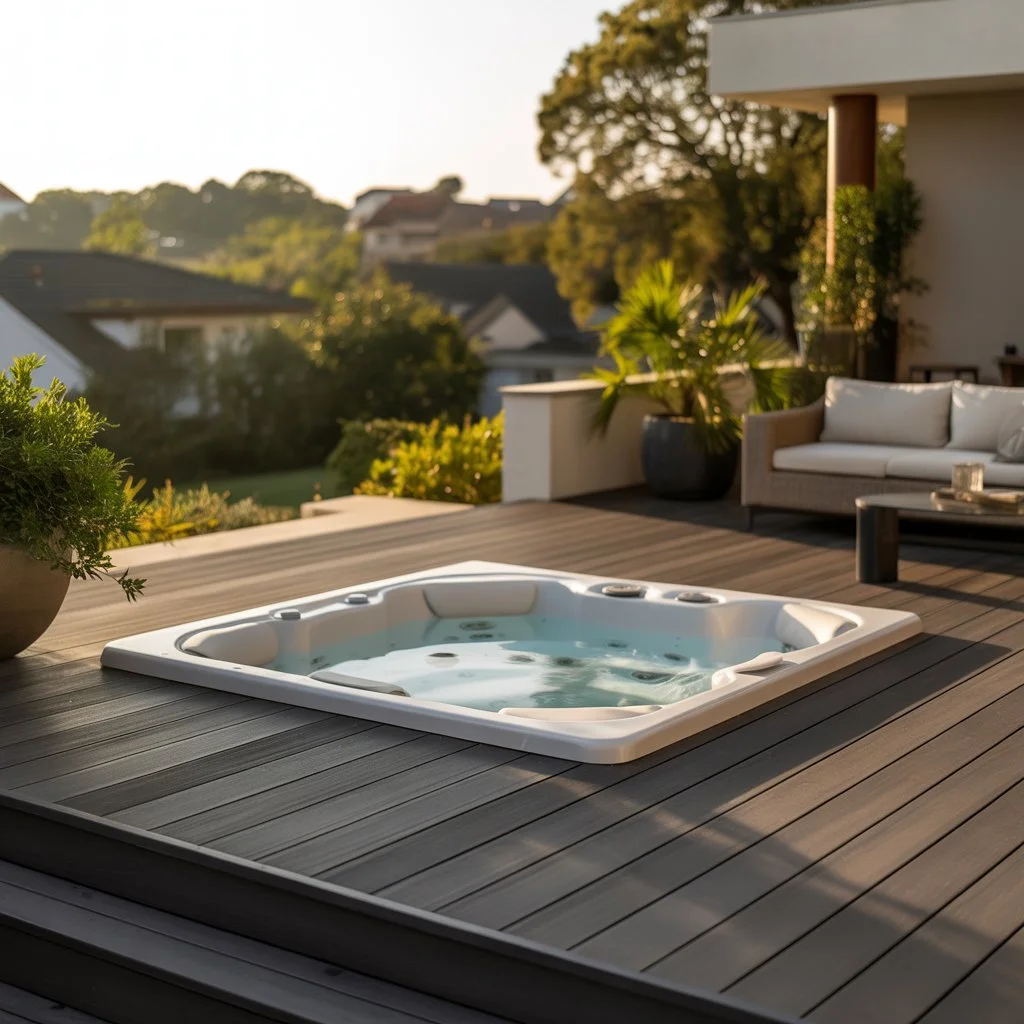
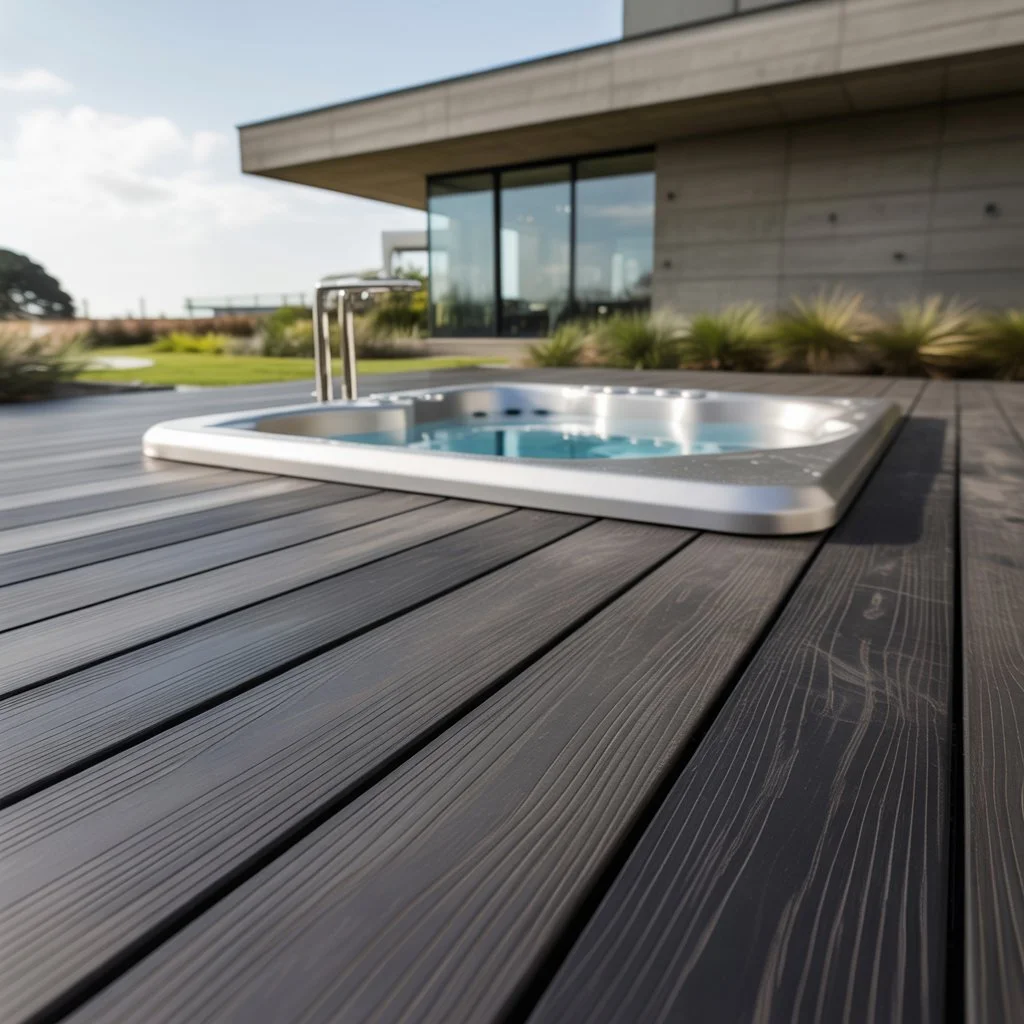
Yes, a hot tub can stand directly on composite decking boards, provided the structure underneath has been suitably reinforced. However, many people choose a so-called recessed installation, where the hot tub stands on a separate foundation and the composite decking boards form only an attractive surround around the top edge of the unit.
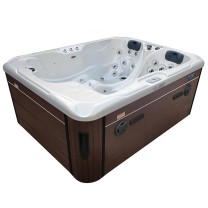
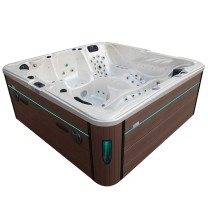
Garden hot tub SPA102 210x160 cm
Hot tub with audio and LED system
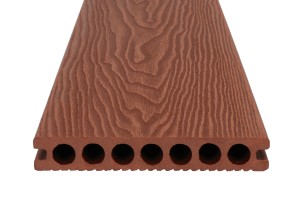
DUO 23x148 composite decking board - 2,25 m
Price per 1 linear metre of board: 21,30 zł
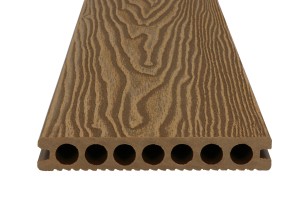
DUO 23x148 composite decking board - 2,9 m
Price per 1 linear metre of board: 21,30 zł



