
How do you choose the length of composite decking boards for a terrace with changes in direction?
How do you choose the length of composite decking boards for a straight terrace, a corner terrace or one with a recess? We explain how to plan the laying direction, minimise cutting and choose length options before ordering materials in autumn.
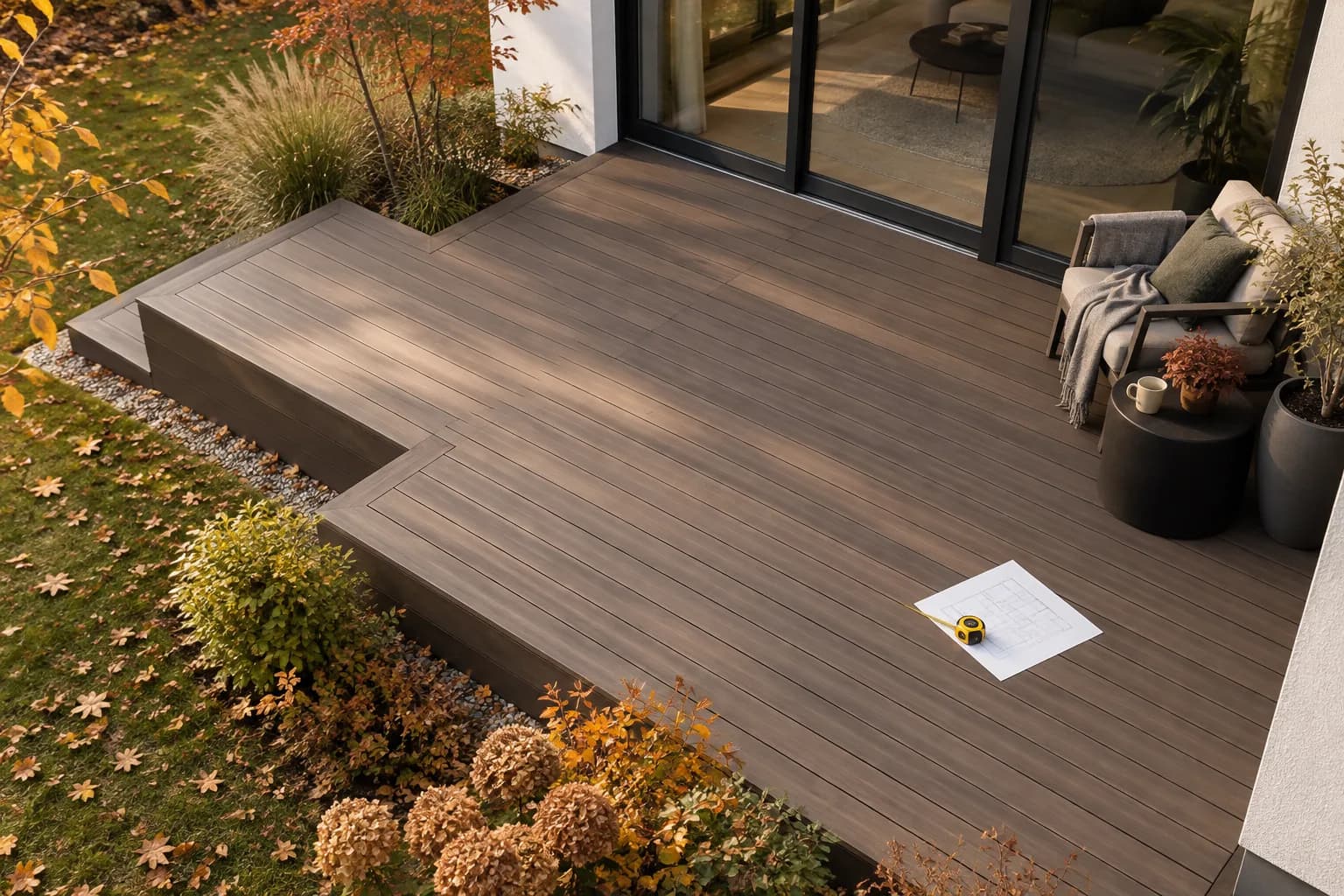
How do you choose the length of composite decking boards for a terrace? First, measure each section separately, decide on the laying direction and mark out where the joints will go. Only then compare the terrace dimensions with the available lengths in your chosen range. Longer boards work well on a straight terrace, reducing the number of joints, while shorter boards may reduce cutting and waste around corners, recesses and short sides.
Autumn is a good time to plan your materials at leisure before the next season. However, it is not worth buying boards based solely on one, longest length. Your decision should be based on the shape of the terrace, the laying pattern and the requirements of the specific system.
Start by measuring the terrace when choosing board lengths
Do not measure the terrace as a rectangle if its shape is more complex. Divide the area into simpler sections: the main rectangle, a recess, a strip alongside the wall, a step or a side extension. For each section, note the dimension along the direction in which the boards will run.
What should you note before buying?
- the length of each board section between edges or planned joints,
- the width of each terrace section,
- the position of posts, steps, recesses and other obstacles,
- the direction of water drainage and the planned edge finish,
- the places where joints will be visible from the main viewing point.
It is worth making a simple drawing showing the direction of the boards. For a terrace next to the house, the relationship between the board length and the width of the façade is often important too. A crosswise layout can make the space look wider, while a lengthwise layout can draw the eye towards the garden. However, this is not a reason to choose an option that results in lots of awkward cuts.
A comparison of the available composite decking boards may be helpful, but the final calculation must be made for the specific range and its installation system.
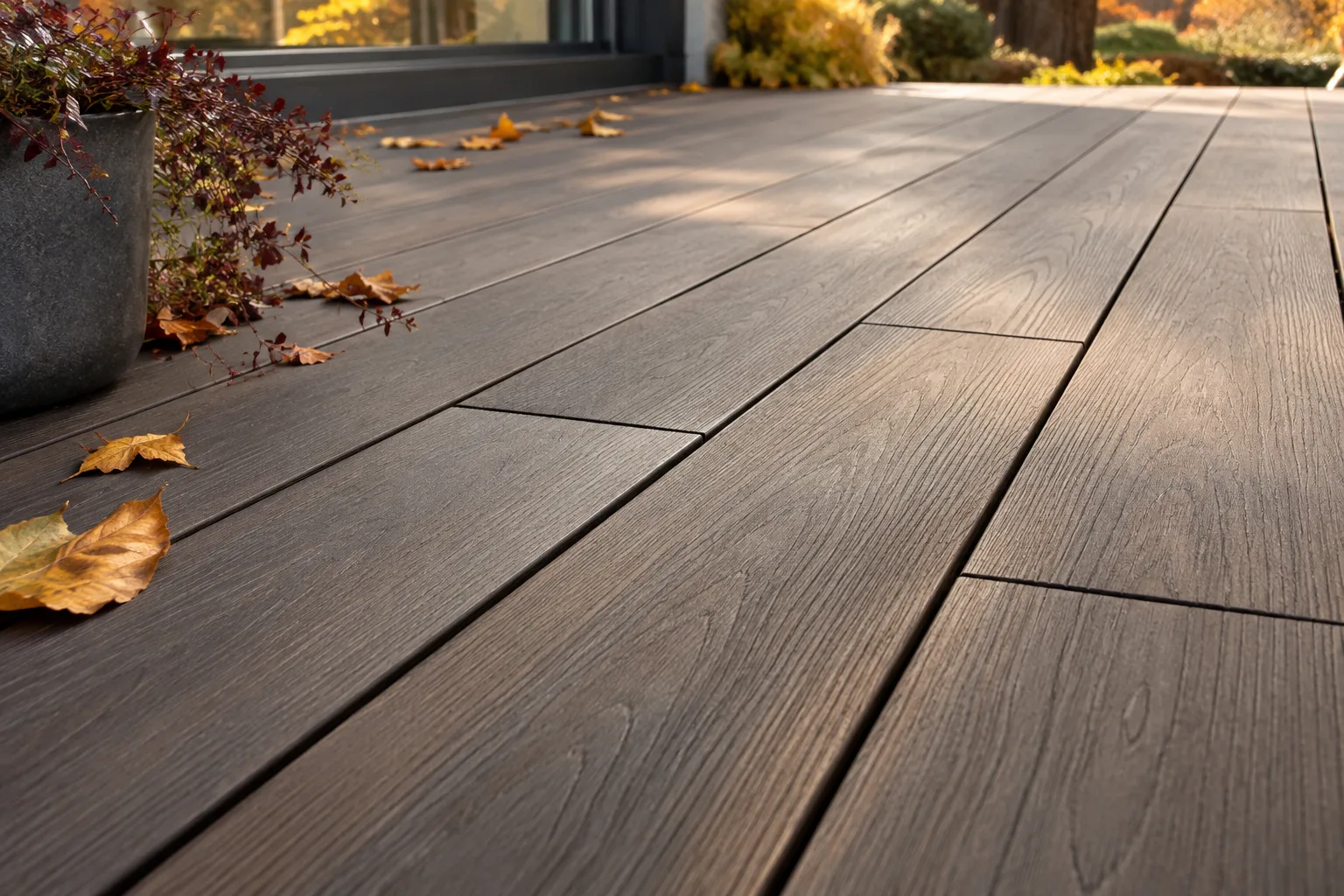
When should you choose shorter boards, and when longer ones?
A longer board does not always mean a better fit. If one side of the terrace measures approximately 2,25 m or 2,9 m, using a shorter option may reduce cutting. On a long, straight stretch of terrace, an option measuring 4 m, 4,5 m, 5 m or 5,8 m may reduce the number of joints, provided that transport, carrying the boards in and the layout of the structure are not an issue.
Example of matching the options
- Terrace with a short side and a recess: consider boards measuring 1,8 m, 2,25 m or 2,9 m. They may make it easier to divide the area into smaller sections.
- Simple terrace alongside a wide façade: compare the 3,5 m, 4 m, 4,5 m and 5 m options, checking where the joints will fall.
- Long stretch with no obstacles: consider 5 m or 5,8 m, but only if the length matches the dimensions of the section and the system instructions.
The DUO range is available in lengths of 1,8 m, 2,25 m, 2,9 m, 3,5 m, 4 m, 4,5 m, 5 m and 5,8 m. One example of a shorter option is the DUO 23x148 decking board, 2,25 m long. This format may be useful when planning short sections, but boards from different ranges should not be mixed without confirming that they are compatible.
The PREMIUM range is available in lengths of 2,25 m, 2,9 m, 3,5 m, 4 m, 4,5 m, 5 m and 5,8 m. If your project requires a section of around 4 m, you could consider the PREMIUM 23x138 decking board, 4 m long. In this case, do not replace the length specified in the catalogue with a rounded value.
The SELECT range options include 1,8 m, 2,25 m, 2,9 m, 3,5 m, 4 m, 4,5 m, 5 m and 5,8 m. For short sections, it is worth checking, for example, the SELECT 25x140 decking board, 2,25 m long. The choice should be based on the layout, not just the range name.
How do you plan the joints and reduce waste?
First, draw the boards to scale or use a simple spreadsheet. Label each section with its length, and note whether any offcuts could be used elsewhere. Do not automatically assume that an offcut from one section will fit another. Whether it can be used depends on the layout, laying direction and requirements for support and fixing.
A practical planning sequence
- Measure the actual dimensions once the ground and structure have been prepared.
- Divide the terrace into sections with a similar laying direction.
- Work out which joints can be placed in less visible areas.
- Compare at least two length options for each section.
- Check whether the chosen range is available in the required lengths in the current catalogue.
- Calculate the number of decking boards separately for each section, rather than multiplying the area by an approximate factor.
A layout with regularly spaced joints may be a good solution, but only if the substructure beneath the boards and the fixing method specified in the instructions allow it. Check the detailed requirements for support spacing, board joints and expansion gaps in the instructions for the specific system. It is also worth comparing a straight layout, a staggered layout and a border layout using the guide on composite decking board laying patterns.
What should you avoid?
- ordering all the decking boards in one length without a layout drawing,
- rounding a measurement of 2,25 m up to 2,3 m when planning your purchase,
- using lengths from one range for another without checking the catalogue,
- planning joints based solely on the area in square metres,
- leaving offcuts at the edges without checking how they will be finished.
Choosing board lengths and finishing your decking in autumn
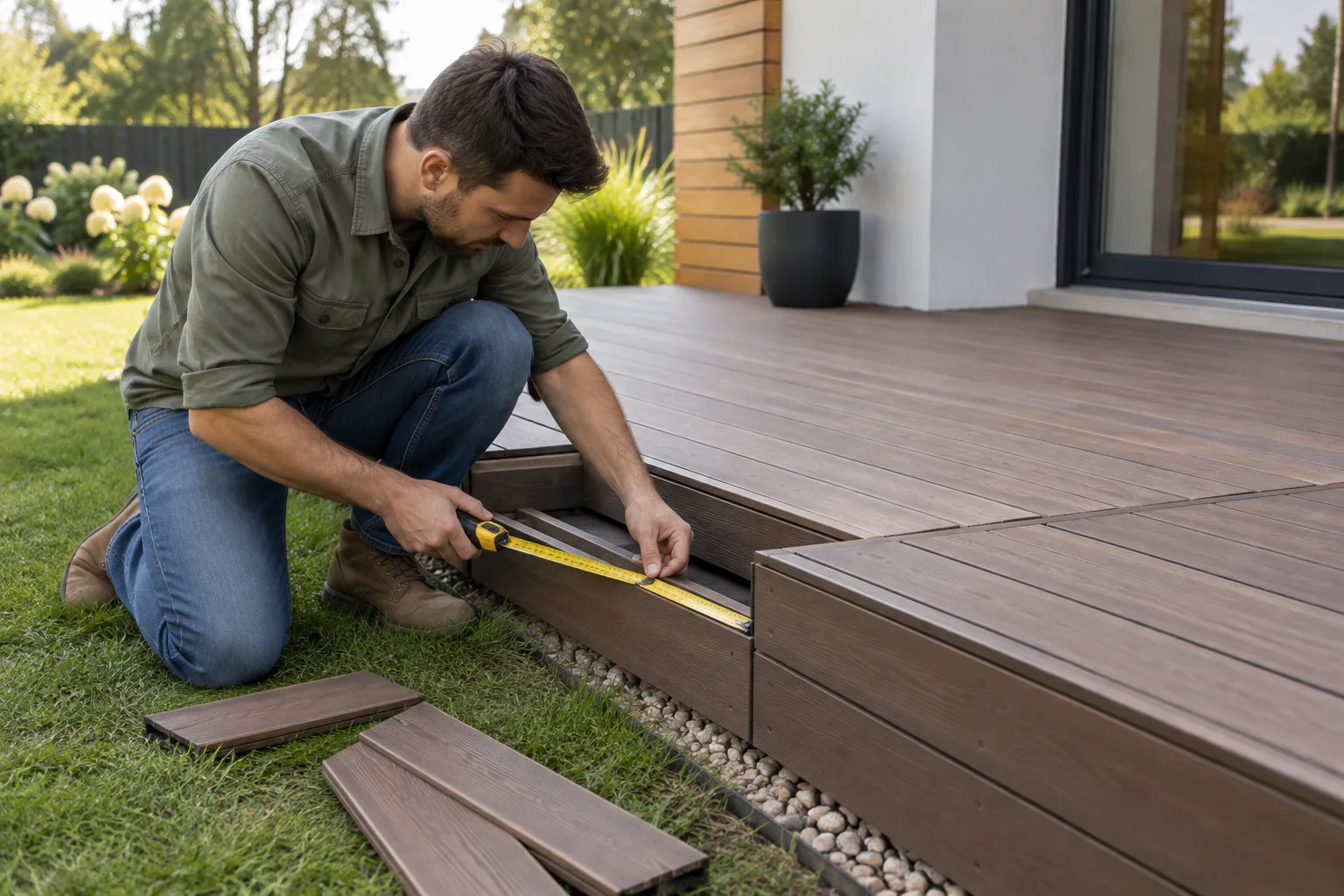
If you are designing your decking in autumn, also plan the order of the work to be done later: ordering the boards, preparing the base, building the substructure and fitting the finishing elements. Before buying, check whether the edges will be finished with a trim, a profile or another component compatible with the system. Finishing can alter the length of the visible section, so it is best not to finalise the board list based solely on the wall measurement.
Choose compatible installation accessories for the decking boards, such as joists, fixing clips, screws and finishing components. The right choice depends on the specific range and decking structure. For help planning the quantities, see the composite decking shopping checklist.
Frequently asked questions
Can you combine different board lengths on one deck?This may be appropriate for a deck with offsets, but you should check that the range, colour, dimensions and fixing system are compatible. Do not combine products just because they look similar.
Does the longest board always reduce waste?No. On short sides, in recesses and around numerous obstacles, a longer board may require more cuts. Compare several options for each section.
Does board length affect the number of joints?Yes, but only in relation to the dimensions of the specific section. A longer option may reduce the number of joints along a straight run, while a shorter one may make better use of the material when the deck is divided into smaller sections.
What should you do before ordering the decking boards?Prepare a drawing showing the dimensions, laying direction and joint positions. Then check the lengths and installation requirements in the current instructions for the chosen range.
Summary: The best board length depends on the geometry of the deck, not on the rule “the longer, the better”. Measure each section separately, compare the available options and plan the joints before buying. The next step is to compare the dimensions with those of a specific range and choose compatible accessories.
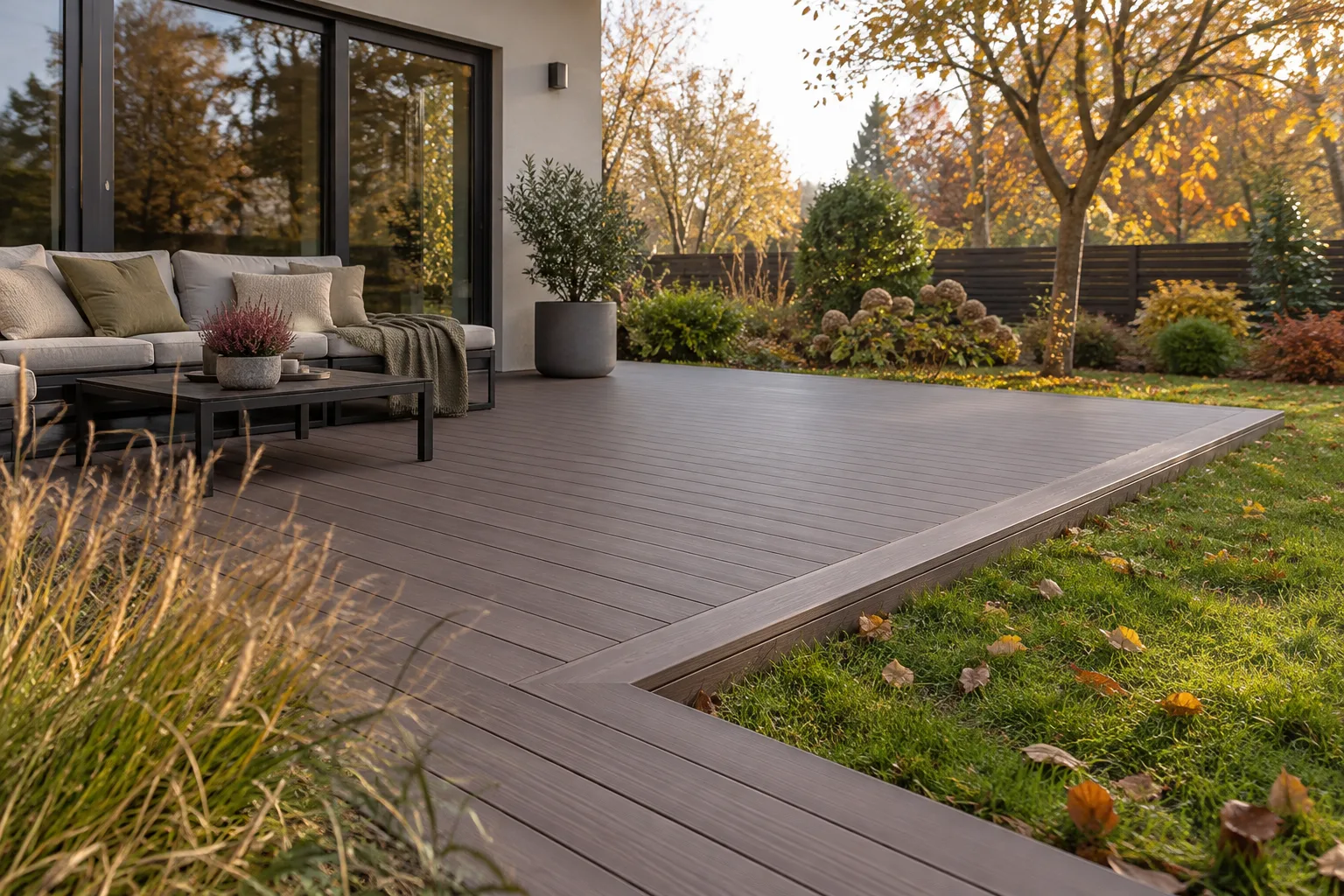
Products for this project
- DUO composite decking board 23x148 - 2.25 m — check the available options and current information on the product page.
- PREMIUM composite decking board 23x138 - 4,0 m — check the available options and current information on the product page.
- SELECT composite decking board 25x140 - 2,25 m — check the available options and current information on the product page.
Read also
- How to avoid waste when building a composite decking terrace: a practical guide.
- Comparing composite decking board installation patterns: straight, staggered and picture frame – impact on waste and appearance.
- What spacing should joists have under composite decking boards? Rules for correct installation.


