
Getting your composite decking ready for autumn – a practical plan
Getting your composite decking ready for autumn does not require complicated measures. Find out how to remove leaves, clear drains, protect your outdoor furniture and check the condition of the decking boards before the rainy season.

Getting your composite decking ready for autumn starts by removing leaves and dirt, checking water drainage and assessing the condition of the decking boards and substructure. The aim is not to impregnate the decking, but to prevent moisture, mud and organic debris from remaining on the surface for long periods.
It is best to carry out an autumn check before the period of frequent rainfall, then repeat it after most of the leaves have fallen. This makes it easier to spot areas where water is collecting on the decking, as well as items that need to be moved or covered.
Remove leaves and prepare the decking surface
Leaves, seeds and small twigs can trap moisture against walls, under furniture and in the gaps between decking boards. First, remove larger debris with a soft brush or broom. Do not drag sharp objects across the surface, as they may leave scratches.
Autumn cleaning, step by step
- Remove leaves, sand and twigs from the entire surface.
- Move furniture, plant pots and storage boxes to clear areas that are usually covered.
- Wash the decking board with water, following the cleaning instructions for the specific range.
- Check that no streaks, mud or residue remain in the grooves after washing.
- Leave the decking to dry and only then check for any stains.
Do not use strong, unsuitable chemicals for everyday dirt. The GARDPOL catalogue includes various types of composite decking boards, so care should follow the instructions for the selected range.
For stains from leaves, grease or soil, do not scrub vigorously straight away. First, remove the dirt with water and a soft brush. If the mark remains, check the system manufacturer's recommendations before using a cleaning product.

Check water drainage and areas around the edges
In autumn, it is particularly important to keep the routes that drain water clear. Leaves can block drainage at the edge of the decking, at a grating or gutter, or in the space beneath it. Standing water is a sign that checks are needed, not a reason to make structural changes yourself without knowing the system.
What should you check before the rainy part of the season?
- whether puddles form on the decking boards after rainfall,
- whether drains and gratings are covered with leaves,
- whether wet organic debris is collecting against the house wall,
- whether the edges and finishing components have come loose,
- whether water or mud is collecting beneath the decking.
Do not drill extra holes in the decking boards or change the joist layout just because you notice a damp patch after one spell of rain. First establish whether the problem is caused by a blocked drain, the position of the outdoor furniture, the ground or the structure. If you are planning an installation or alteration, follow the instructions for the specific system.
The condition of the areas by walls and in corners is also important. Plant pots placed directly on the decking, leaves stuck to a wet surface and closed storage boxes can slow drying. Move items and clean these areas regularly.
Choosing decking boards and planning the autumn layout
An autumn check can be a good opportunity to assess whether your planned board layout will reduce the number of joints and cuts. The SELECT range is available in the following lengths: 1,8 m, 2,25 m, 2,9 m, 3,5 m, 4 m, 4,5 m, 5 m and 5,8 m. A shorter board may suit a small balcony or an area by the stairs, while a longer option may reduce the number of joints across a larger area. The final choice depends on the dimensions of the decking and the direction in which the boards are laid.
For example, a 1,8 m-long SELECT 25x140 decking board could be considered for shorter sections, while a 5 m-long SELECT option could be considered for a larger, straight area. This does not mean that the longest board will always be the best choice: with an unusually shaped decking area, it may increase the amount of waste from cutting.

Protect your outdoor furniture and plan checks after rainfall
There is no need to automatically remove all furniture from the decking in autumn. However, it is worth checking whether the feet are trapping water and whether leaves are collecting under heavy items. Store textiles, cushions and lightweight decorations in a dry place, or bring them in before rainfall.
Arrange planters left on the patio so that you can clean the space beneath them regularly. Do not cover drains with large covers or plastic sheeting. If you use covers, they should fit the furnishings and not form pockets where water can collect.
A simple autumn schedule
- Before the first frequent rainfall: wash the patio, clear the drains and check the edges.
- After strong winds: remove branches and leaves, especially from the corners.
- After heavy rain: check whether the water drains away and whether any new puddles appear.
- Before winter: give the patio a thorough clean and put away textile items.
If you are planning a new patio, when designing it in autumn consider not only its appearance, but also access to drains, the ability to move furniture and ease of cleaning. The DUO series is available in lengths from 1,8 m to 5,8 m, including 2,25 m, 2,9 m, 3,5 m, 4 m, 4,5 m and 5 m. This lets you match the material to the layout of your patio instead of designing the surface around just one length.
If you are considering a solid decking board for a heavily used area, also take a look at Full Premium 20x140 board, 3,5 m long. The catalogue lists FULL PREMIUM boards in lengths from 3,5 m to 5,8 m; however, do not assume that their features apply to other series without checking the details of the specific product.
Common mistakes before winter
- leaving wet leaves beneath furniture and planters,
- cleaning with a sharp tool or stiff brush without checking the recommendations,
- covering drains with airtight plastic sheeting,
- using a random wood treatment on composite decking boards,
- making structural changes without the system instructions,
- ordering only the longest boards without checking the cutting plan.
Questions and answers
Does composite decking need impregnating before autumn?Do not assume this treatment is needed unless it is recommended for the specific series. The basics of autumn maintenance are removing leaves, cleaning in accordance with the instructions and checking that water can drain away.
How often should leaves be removed from the patio?After strong winds and whenever wet leaves begin to form a compact layer. If the patio is surrounded by trees, it is worth checking the surface more often.
Can garden furniture be left on composite decking boards?Yes, but check the space beneath them, remove leaves and prevent moisture from lingering for long periods. It is best to store textiles in a dry place.
What should I do if a puddle remains after rain?First, clean the surface and the drain. If the problem recurs, check the structure and the system instructions rather than drilling or altering patio components yourself.
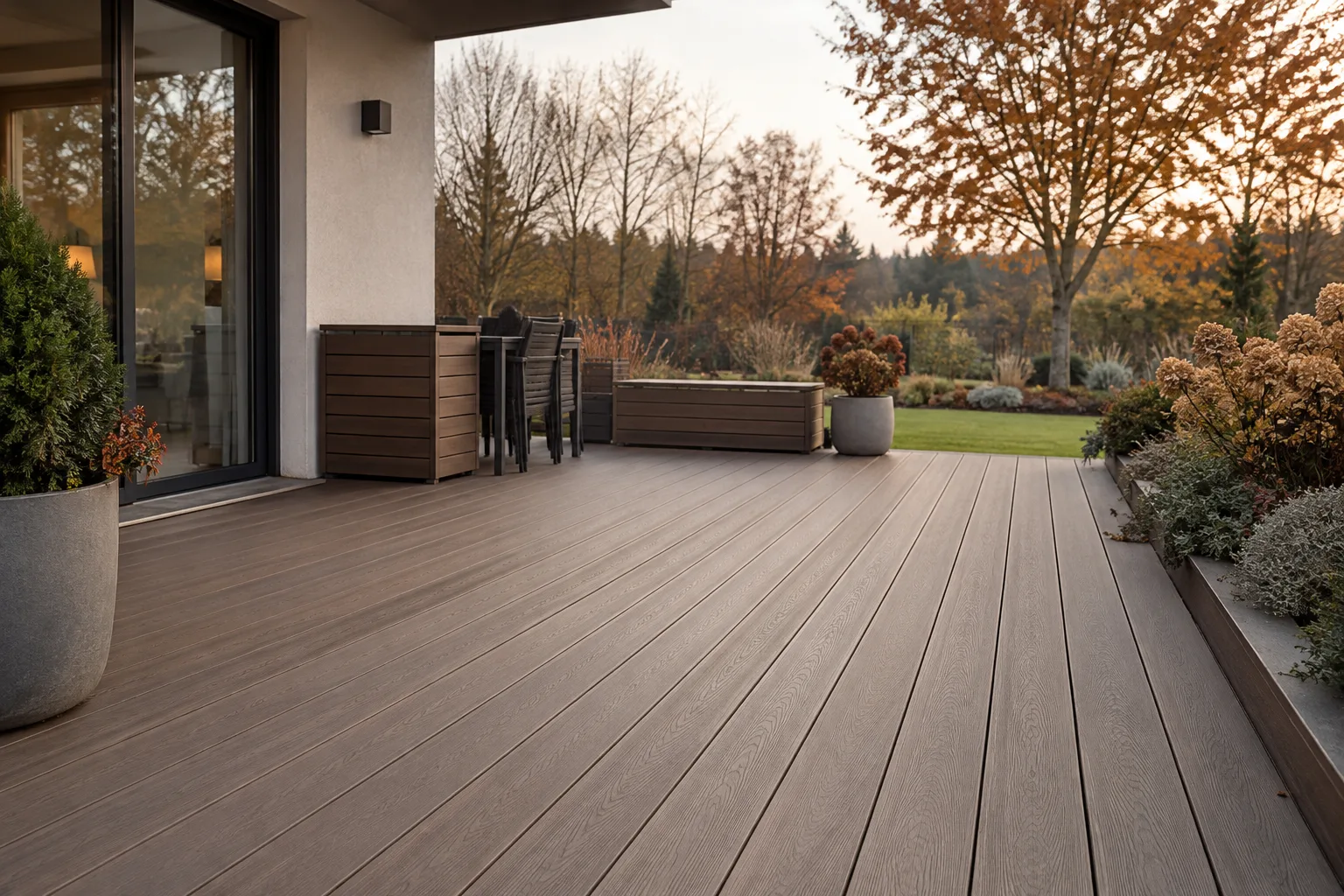
Summary: an autumn inspection instead of difficult renovation
Preparing a composite patio for autumn comes down to regularly removing leaves, cleaning in accordance with the instructions, checking drainage and sensibly protecting the furnishings. After the inspection, note any areas that need monitoring and check them after the next heavy rainfall. If you are only planning a patio, compare the available series, board lengths and layouts in the catalogue, then choose a solution to suit the dimensions and how you intend to use the space.
Products for this project
- SELECT composite decking board 25x140 - 1,8 m — check the available options and current information on the product page.
- DUO composite decking board 23x148 - 2,25 m — check the available options and current information on the product page.
- Full Premium composite decking board 20x140 - 3,5 m — check the available options and current information on the product page.


